
330: Sullivan Fortner
It is hard to overstate the exuberance and awe expressed by other musicians when talking about Sullivan Fortner. At under 40 years old, he is one of a small handful of pianists who have moved the instrument and its potential forward. And by doing so, he’s demonstrated that innovation can happen from within the tradition of what came before rather than reinventing it outright.
To those who know, he is both a living reality and, as my friend Alix, a jazz club owner in Spain, recently described him to me, “a divine apparition.” When speaking about him, one need only invoke his first name. It’s enough. It says everything. If Sullivan is involved, you know it’s worth checking out.
Sullivan will tell you that his first instrument was the organ. He started out playing in the church in New Orleans. It was there that he learned to accompany singers, to follow his ear, and above all, to keep time. His grandmother made sure of that.
It was also where he first learned to shape sound, pulling stops and, as he puts it, “mixing flutes together.”
That early fascination with sound has never left him. On his latest record, Leave That In There, what began as an acoustic trio session eventually expanded into something much harder to categorize, with synthesizers, overdubs, percussion, singing and studio experimentation layered into and around the original performances.
You can hear the same curiosity on his previous double album, Solo Game. One side, “Solo,” is Sullivan alone at the piano. The other, “Game,” finds him playing keyboards, singing, programming, experimenting and searching.
But Sullivan’s influence may be even deeper as an accompanist and collaborator. Melissa Aldana, Lage Lund, Peter Bernstein, Kassa Overall, José James, Dida Pelled, Lauren Henderson, Kurt Elling and Samara Joy, all past guests on this podcast, have in one way or another been forged in Fortner’s fires.
He is particularly special for singers. Playing with Sullivan has increasingly become a kind of rite of passage for jazz vocalists.
And while he says he tries to treat the music with the same respect no matter who he plays with, there is an unquestionable connection between Fortner and his partner in life and often in music, Cécile McLorin Salvant, who is as much a force of nature in her own right as she is a fact of life. (If Sullivan has helped redefine how the piano can be played today, Cécile has done the same as a vocalist and performer. And like Sullivan, the jazz world is on a first-name basis with her.)
What is striking to me about talking to Sullivan is his humility, his humor and his general humanity. He is a cat. He’s funny, self-reflective, someone who is very much in it: in the music, in the life, in the process of discovery.
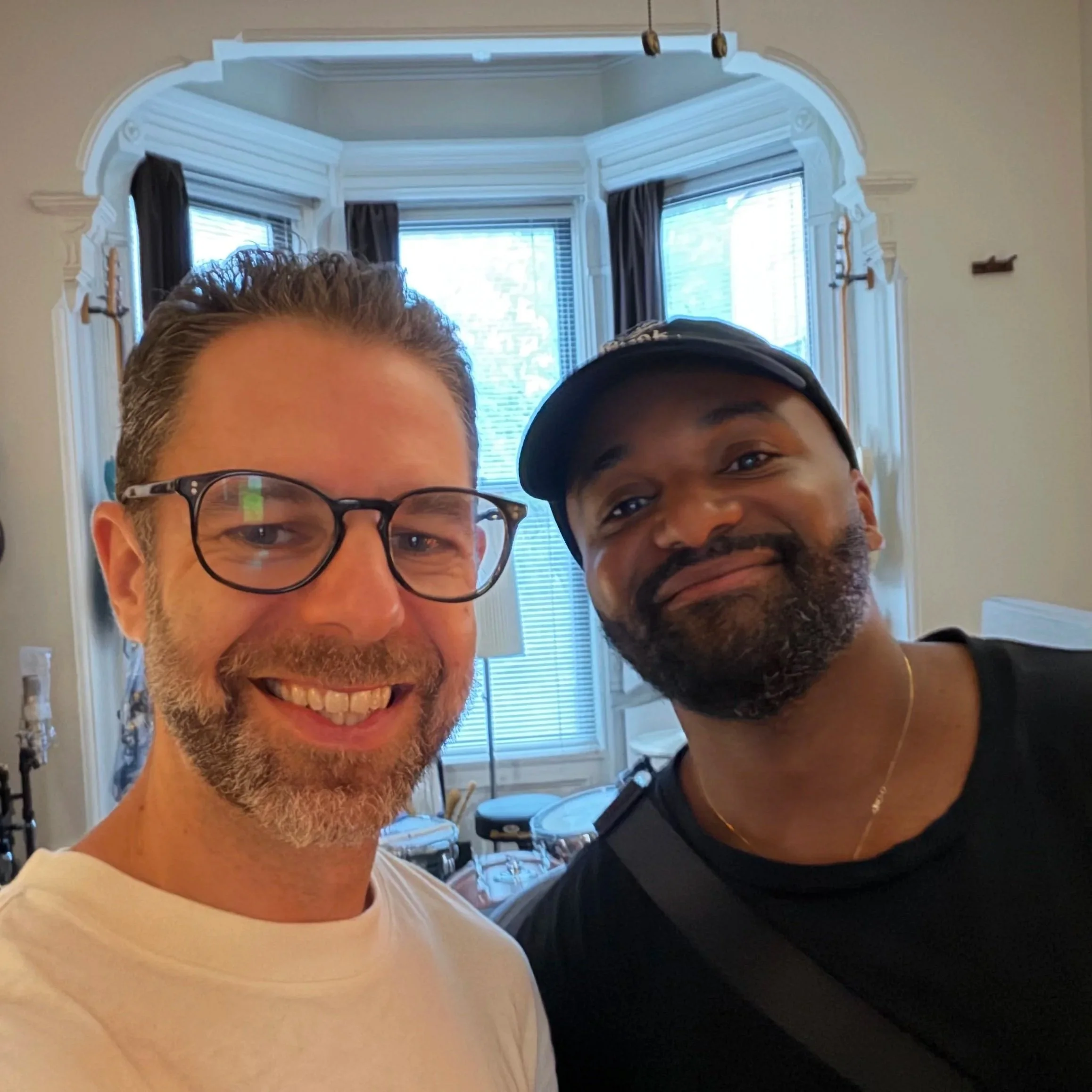
With Sullivan Fortner in Brooklyn, September 2026
We got together recently to talk about growing up in New Orleans and his early development as a musician; about how he nearly became a doctor instead, and his decision to honor the gifts he had clearly been given; about the path that took him from the backbeat of the bayou to the back woods of the Buckeye State, and eventually to New York.
He told me he can’t imagine a time in his career when he doesn’t have some kind of teacher or mentor to help guide him, no matter how established he is. We talked about the teachers and mentors who shaped and guided him, from his first teacher Peter Martin, to Fred Hersch who became a kind of guardian angel later on.
And especially about Barry Harris, whose teaching deepened Sullivan’s understanding of a musical language he was already speaking and, in the process, reoriented him as a musician. Barry’s class was also where Sullivan first befriended Cécile.
He talked about his early professional experiences playing with Stefon Harris and Roy Hargrove, and learning to listen for the lesson rather than waiting for someone to explain it. He talked about literally tasting music, searching for unfamiliar sounds in the studio, and about how his partnership with Cécile has shaped his approach to music and life, from the bandstand to the kitchen and beyond.
This is, I think, one of my favorite conversations.